Art Therapy on a Residential Treatment Team for Troubled Children Journal of Care 2 P 6171
 Listen to this
practice
Art therapy on a residential treatment team for troubled children
Anne Mills
Editor�due south Notation: Creativity represents the virtually authentic expression of the Self. In our adult globe of structured linguistic communication and formalized concepts, the confused earth of the troubled child oft struggles in helpless silence. Unfortunately, clinical psychologists take led many practitioners to believe that Fine art Therapy is but valuable to clinicians trained to interpret such expressions through intimidating theories and profound insights. In this article, Anne Mills minimizes the significance of theoretical underpinnings and liberates creative expression as a procedure valuable in its own right.
With the employ of interesting examples, Anne demonstrates how Art Therapists and Child Care Workers tin interact to better sympathise the inner life of children. In a profession that oftentimes becomes tediously focussed upon observable behavior that must be changed through various forms of overt and covert manipulation, she offers exciting possibilities for the curious and creative practitioner.
What we really capeesh most this stimulating commodity is that the client is respected as the skilful on his or her own inner experience while the practitioner is invited to assume the more humble position of learning something from the kid �at least for some of the fourth dimension.
A 7-twelvemonth-old male child who was very articulate in many areas found it almost impossible to talk well-nigh his feelings. Every bit a client in a residential treatment programme, he may have been feeling lost among the other children, and a little solitary or angry at his family unit. He may take been dislocated about himself-he was intellectually gifted but couldn�t learn to read. Yet he carried this and other problems around inside him, �Similar a little former man." as 1 kid intendance worker put it.
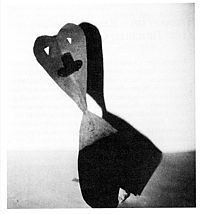
Effigy 1. Sob. 14" high. Construction paper, popsicle sticks, masking record, oil pastel
In art therapy, this male child made the paper sculpture alien, whom he called �Sob" (see Figure ane). Sob�due south body is well-nigh cutting off from his head; he has trouble standing upwards straight, his mouth has been �X-ed" out. Spontaneously, the piddling male child began to speak through Sob, to allow the art therapy product to limited what he himself could not say. �I am running. There�s something in my eyes. Information technology�south hard to live on Earth. I can�t exhale, I take no lungs. I am entirely fabricated upwardly of eye."
The boy continued to converse with the art therapist for some fourth dimension using Sob every bit spokesman, When his sessions ended after six months of art therapy, he took this special product with him and gave it to his main care worker as a gift. This may have been expressive of how she had, like Sob, helped him with his difficulties in communicating his emotions.
This case of how i detail child related to the feel of art therapy tells us much about his relationship to himself, to his primary care worker, and to the fine art therapist. However, the almost striking element of this case is that the boy related to the art materials, in the context of the relationship with the therapist, as a means to create things which would and so allow him to evoke hidden aspects of himself.
That the goals of child care and art therapy in this instance paralleled each other attests to a common view of the child by each field, That dissimilar methods were used by kid intendance workers and fine art therapists with this child (fifty-fifty toward the same goals) hints at potential misunderstandings between approaches which tin arise when there is no avenue for communication between fields, or a lack of information nearly another�due south field, and it suggests the need to accost these problems. To that stop, I would like to look at the question of �who are art therapists?"
Of the many definitions available, the one I would offer is that an fine art therapist is an creative person trained to do psychotherapy, using art as the main tool. Ordinarily, an art therapist has received a Primary�due south degree in Art Therapy later on two years of specialized study following a Bachelor of Arts in Fine art and Psychology.
The art therapist typically sees the customer privately once a week for the fifty-minute hour common to psychotherapy. The art therapist will use basic art materials (some kind of modelling fabric, tools for drawing and painting). If the client is a child, other materials an individual therapist finds helpful, such as sand play, h2o play, or dolls, may be used.
Art therapy is used with all kinds of populations: �normal" people seeking more insight into themselves, the elderly, people with psychiatric problems, families, and so on. Where there is a barrier to advice, equally with mute, mentally retarded, or physically handicapped children, communicating through art tin can exist a distinct advantage. Fine art is especially advisable for children due to its playfulness and familiarity.
The value of fine art therapy to the children
The value of art as therapy for disturbed children rests on this fact, plus the remarkable tendency of each child to utilize the encounter with art therapy in his or her own personal way. Permission has been obtained to employ the fine art piece of work of children from a preadolescent treatment centre to illustrate some of the ways they related to the art therapy process in order to fulfill needs they could not enunciate. The detail examples show the use of art therapy for total emotional expression without fearfulness; ventilation and containment; concreteness; nonverbal communication; and �as if" information technology is the real world.
Full emotional expression without fear
Most troubled children have a demand to express their emotions still certain children in residential intendance may fear genuine cocky-disclosure, peradventure because of the turbulent feelings it releases, or because what is disclosed does not conform to the �function" they play in their everyday life.
Scribbling, painting, and modelling are, however, activities virtually children are not resistant to, for they are familiar with and interested in such �play." For these children, the rationalization of �information technology�due south merely art" allows them to ventilate their emotions in a spontaneous fashion.
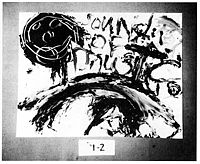
Figure 2. Sound of Music. Finger paint.
An eleven-year-old boy on the brink of adolescence had a dramatic, performing ego (Figure 2). We can see by the composition, the finger strokes, etc., that he used the art therapy process to express the emotions and free energy that sometimes overwhelmed him.
He could practise this without the sullenness or the acting out that he often showed in family unit meetings. He seemed able to evade his fright of real emotion by denying that annihilation significant went on during his art therapy session. He threw himself �into battle" with the fine art materials in a style that seemed to narrate the battle within himself.
Ventilation and containment
Many people can sense at some deep level what they need most from art therapy, and without realizing it, will consciously utilize the therapist, the time, and the materials in social club to reach it. When one is too much in contact with 1�s emotions or with more primitive ways of operation, the �psychic balance" may generally need less regression and more control.
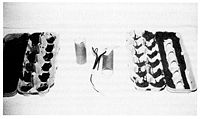
Figure three. Colored paint in egg cartons. Cardboard and pipe cleaner product non discussed in text.
This latter need is illustrated by the artwork of an eight-twelvemonth-quondam male child. On his arrival at the residential treatment centre, this child had many animal-like behaviors, despite his intellectual precocity. He sought for himself the containers, the boundaries, the self-command that would appropriately hold his archaic art products (Figure 3, Colored paint in egg cartons) which he referred to as blood, urine, and feces. (Notice the lack of stardom between primitive body production and primitive fine art product.) Torn between his demand to regress and his need to grow, the art piece of work may represent a desire for his primitive feelings, to be both accepted and contained.
This male child likewise made some very sophisticated art products which showed his ability to maintain control at times, as a sensual appreciation for materials and visual subtleties, A special benefit of the art therapy for him was the chance to discover art techniques on his own by exploring media. This art time, in addition to his school or treatment centre art time, may accept aided the development both of his creative gifts and his sense of cocky.
Concreteness
The ability to think abstractly is developed slowly by children every bit they mature. Some of the situations that have an affect on their entering residential handling, for example, may exist hard for them to grasp. Children are more capable of understanding things stated in a physical fashion, and are further aided past physical cues, sensations, etc. Memory, too, is reinforced by having a physical reminder of an outcome.
Similar adults, children utilize metaphors or symbols naturally. They can find or create a concrete image that expresses one or many meanings for them.
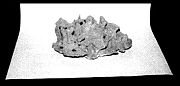
Effigy 4. Volcano / Rock from Mars. Self-hardening clay, red pigment. 10" diameter.
Effigy iv was done by a x-year-erstwhile boy from a background with a long history of family violence, who appeared to be perpetuating this family blueprint. It looked equally if he wanted to warn me off and address himself to his own aggressive tendencies. The production is a volcano fashioned with emotional vigor visible in its securely textured surface. He said, �This is a stone from Mars. It could hurt you," with much threatening intensity. Rejection by his mother, having already been abased by his father, may have triggered his fear of death, in a child's irrational way, (Loss of parents� love, for example, is a common theme in fairy tales in which the child is left in the woods to die,) No child feels more helpless than when he or she has lost parental dearest and with information technology the expectation of protection from danger. This particular boy�s aggression and fear combined to create a morbid fascination with decease, embodied in the physical image of the volcano.
Nonverbal communication
The art therapist will elicit remarks from the child almost what is going on in his or her picture. This helps the therapist learn the unique �visual language" of that kid. Training in interpreting symbols in art, and familiarity with all developmental aspects of children'south art will help the fine art therapist even when the creator has been unable to verbally share information virtually its content.
The ability to limited concerns verbally is not completely developed in children who may neither be able to nor wish to talk near their issues. Sharing through art can be a neat relief for troubled children who feel they have a secret they want to tell, simply which is too �terrible" to reveal verbally.
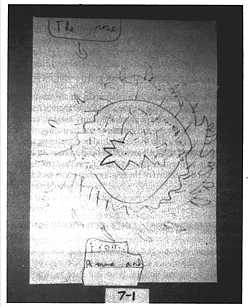
Effigy 5. The Rose. 36" x 48". Red and orange markers. Joint cartoon by client and therapist.
In Figure v nosotros see the cardinal motif is an �heart" shape, and that the flower, which is the picture�due south subject field, is and then huge that it fills the page. A nine-twelvemonth-old girl seems to be telling her hush-hush-almost shouting her secret, given the size of the drawing (48" 10 36") and her euphoria at doing it.
Art therapy researchers have noticed what seems to be a pregnant frequency of wedge or eye shapes, or of a scarlet flower, in the drawings of women and girls who have been sexually abused (Leap, Abbenante, Silvercloud, & Meixner, (1984). Because of this and this child'south case history, the therapist could perceive this picture equally the girl talking almost sexual corruption she had experienced. Creating and contemplating this and other drawings seemed to have a positive issue on this kid. Creation of the fine art product externalized the child's inner world. The art�s content could then exist explored with lessened emotional turmoil.
"Equally if" it is real life
At certain stages a child's idea is �magical �information technology is �every bit if" something is so because the child is supposing it to exist then, The child's interim out of his or her fantasies in fine art therapy is not only a window on their desires, but is as well a useful therapeutic tool in helping disturbed children �1ay to rest� wishful thinking that may preoccupy them, thus allowing them to move frontward in their lives.
The rehearsal of new behaviors, which children seem to do in art therapy, may happen as a prelude to modify in their behavior. In these situations, the art therapist plays a delicate role in keeping inside the session (and not in the real world), interim out behaviors through symbolic art activities.
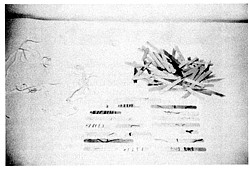
Effigy 6. Broken string, broken popsicle. Sticks with drawings.
An eight-twelvemonth-old boy depicted himself and his adoptive family in popsicle sticks. It seemed as if he were actually manipulating these individuals. Afterwards his tie to this adoptive family was severed, his hopes turned to aggressive feelings, which he began to work through by expressing a fantasy of ability, breaking the objects symbolic of his family, and cutting strings (see Figure six).
The relationship between child and art therapist
An art therapy product is quite a different thing in subtle ways from artwork made at other times. For instance, the protocols of the art therapist in limiting fourth dimension or presenting materials is different from other art-making times the child experiences, Farther, the therapeutic decisions made during the grade of a session structure the feel so that information technology is felt to be containing and safe by the child, yet is moving toward hard areas that need to be examined. The most important difference in setting apart the art therapy product from other artworks is that it was created in the context of the relationship between the child and the therapist.
Information technology is more than the simple presence of the therapist which defines the fourth dimension as therapy. It is the way the child acts in this human relationship which is of smashing interest to the art therapist. Many art therapists working in the psychodynamic mode mutual today in Canada remember that this may re-enact how the child behaved or felt in previous important relationships (Rubin, 1984). In re-enacting these behaviors without witting awareness, the child projects sure mental or emotional constructs onto the therapist. The art therapist, to facilitate this, aims to remain neutral both to take the projections (every bit does a screen) and non to react to the kid'due south expectations. Many fine art therapists experience this �transference," as it is chosen, is similar a river that carries the therapy forrad.
Considering of the protocols of this approach, a child'due south need to be hugged, for instance, is probably not a need that would exist gratified during a session. Just when the session ends, the child goes back to the principal care worker and tin have this particular need satisfied in a very positive and reinforcing mode.
In considering an fine art therapy product, the therapist seeks to understand all the processes of its creation: the transference, mannerisms, hesitations, random remarks, selection of media, nonverbal behavior. The weighing of all these aspects to forma total movie of the child is based on the belief that all behavior, and hence all products such equally art are meaningful.
Art made outside the formal �frame" of protocols, the transference relationship, etc., lacks this information for the art therapist. Hence, other fine art products cannot be assessed with every bit much sensitivity or accuracy.
The relationship between child care worker and art therapist
The main difference betwixt a kid care worker and an fine art therapist is the focus of their attention with a kid. With the kid care worker it might exist the behavior of the child in terms of what is considered adequate behavior in a reality-based approach, related to the socialization process. For the art therapist the behavior may exist considered a form of communication, albeit a distorted bulletin at times, which is available for analysis.
The do good of a two-pronged arroyo for treating both the motivation and the outcome will exist more effective in the long term than treating either factor in isolation, A constant interchange between child care worker and art therapist tin give some way of coping with frustratingly incomprehensible behavior by understanding what lies behind it, and for testing out hypotheses most a child's dynamics past checking them against the realities of data from �the other 23 hours" of a child's life. It helps lead both kinds of workers away from a i-sided view of the child.
Most of the bug that may arise between the child intendance workers and art therapists may probably be traced to their unlike focuses on behavior and motivation, 1 difficulty was touched on in relation to the girl who drew �The Rose" (Figure five). Considering of the premium placed on behavior, primary care workers often hope to hear that a child in art therapy has been able to openly discuss a trouble. They can experience somewhat disappointed if this does not occur. Hither, the verbal cocky-disclosure is targeted as a curt-term goal which is not necessarily shared past the art therapist. Thus, although the long-term goals are the same, the methods, protocols, and terminology differ at times.
The structure of working in the fifty-minute private session can set up a situation in which the fine art therapist is seen more as a consultant to the team, rather than a fellow member of the team. Openness to the validity of each other�due south views with the assumption that no one person has all the answers about a child, is the most productive and creative model in working treatment teams. Creating this structure in a multidisciplinary staff, plus the mechanisms for �touching base of operations" between fine art therapist and kid care worker, heighten the quality of treatment offered to the client.
Primary care workers sometimes evidence incertitude most the value of art therapy for children but are interested in play therapy. In fact there are many important affinities betwixt art and play therapy; they tin resemble each other in materials used and procedures followed. Furthermore, most fine art therapists have some familiarity with dramatic play (plus music or movement every bit therapeutic modalities) in add-on to fine art. This is so they feel comfortable following a child equally he or she uses the therapy time to fulfill his or her needs. Often a child will move spontaneously, from painting a scene to acting it out, or incorporating puppets into a discussion of his or her artwork (Rubin, 1984).
However, the fine art therapist always comes back to the art, which remains the key focus. This specialization in art, with stiff training in the process of therapy, is how the art therapist is different from other professionals who use art in their treatment.
The value of an art therapy program to an institution
Fine art therapy, as an effective modality for working with children, may be a valuable improver to the multidisciplinary squad. There are, for instance, needs that cannot be met by traditional residential environments. A one-to-one therapeutic run across centres on the individual child, and helps to place those needs. The procedure of the therapy begins to reply to each kid's differing needs, according to the client�s ain pacing and priorities. The examples above are a few of the possible ways children tin can relate to the materials and the therapist.
Through art therapy, less censored, less conscious, more emotional material is easily reached, This is because doing art can provide a directly and rich encounter with the realm of dreams, imagery, and impulses in each one of us, This ways the art therapist volition have data to offering the team that may complement that of other staff. Information gained largely through nonverbal processes is likely to assistance united states all reach a more complete and rounded view of the client.
Many adult institutions utilize art therapy in assessment or diagnosis, and it can exist of benefit in the formulation of treatment plans for children as well. Whether in a one-time assessment interview or in continuing therapy, the art products can be used for their predictive and evaluative qualities. Sure signs may give early on warning of more serious psychopathology, and clues may emerge to the source of by trauma.
In summary, by bringing a unique perspective to the understanding of the dynamics of a child's disturbance and by offering nevertheless another tool for facilitating the resolution of that disturbance, art therapy contributes significantly to the quality and range of treatment the treatment squad is able to supply.
References
Feder, B., & Feder, E. (1981). The expressive arts therapies. Englewood Cliffs, NJ: Prentice-Hall.
Kramer, E. (1979). Childhood and art therapy: Notes on theory and application. New York: Schocken.
Rubin, J ,A. (1984). The fine art of fine art therapy. New York: Brunner /Mazel.
Jump, D., Abbenante, J., silvercloud, B., & Meixner, D.Fifty. (1984). The serenity trauma: Symbolic language of the sexually abused gives predictive clues. Paper presented at the American Fine art Therapy Association Conference, Washington, 9. Bound, D., Abbenante, J.
This feature: Mills, A. (1991) Fine art therapy on a residential handling team for troubled children. Journal of Kid and Youth Intendance, Vol.6 No.four pp 49-59
0 Response to "Art Therapy on a Residential Treatment Team for Troubled Children Journal of Care 2 P 6171"
Post a Comment