How Does the Time Read Da Vinci Resolve
Stormy atmospheric condition and decision making
Remember the days before GPS? The not-so-proficient old days, dorsum when newspaper maps and outdated road signs were the only way to find new places?
For those of you who never experienced life earlier Google Maps and AI voice assistants, permit me describe what it was like. Y'all were completely dependent on your own sense of direction, your familiarity with the road, and your ability to clearly see what was around y'all.
This actually worked ok every bit long every bit weather condition were clear and you lot already knew how to become where you were going.
But equally shortly every bit the sun went downwards or the weather turned bad, your ability to navigate brutal off a cliff (so did your car if you weren't conscientious). And the worse the conditions, the harder it was to make decisions nearly which manner to become.
For post professionals, that's non too different from trying to make creative decisions without real-time playback in your NLE.
Think almost the final time you had to cut, grade, or mix without smoothen playback. Not but was information technology dull and frustrating, but it likely hampered your creative controlling. Choosing the best accept of an actor's functioning, or deciding where to cut a scene based on emotional cues is hard when you can't watch a video smoothly.
When it comes to finding your way in a timeline, real-time playback is merely as important as GPS when driving in a storm. Without clear vision, it's challenging to make effective creative decisions for your film.
In today's commodity, I'll show you the five best ways to optimize performance in DaVinci Resolve, so your artistic decisions are as smooth and real-time equally possible.
How to measure playback performance
Before you lot tin optimize the playback performance of DaVinci Resolve, y'all need to know how information technology'due south doing already.
In Resolve, at that place is a Operation Indicator Light and a Frames Per Second (FPS) display in the top left corner of the principal viewer window.
As yous might have guessed, the Performance Indicator tells y'all whether overall organization resources can obtain real-fourth dimension playback, or a smoothen playback experience, and the FPS display tells you how many frames the system can deliver every second.
A dark-green performance indicator ways the system is achieving real-time playback, while a red indicator means that there are not enough system resources available for real-time playback.
Note: A red low-cal might signal a limitation on CPU, GPU, or storage resources, or any combination of the three.
Luckily, if you detect yourself in the uncomfortable situation where you can't deliver real-time playback, there are a number of features and options available to enhance your operation without whatever change to the final export quality.
While it may seem redundant to accept multiple features for what seems like a similar purpose, each feature is unique and useful in different situations and hardware configurations.
i. Performance Mode & other playback tweaks
Performance Mode is a fantastic characteristic that was recently added to DaVinci Resolve.
It intelligently analyzes your computer'due south hardware configuration and automatically adjusts Resolve's image processing nether the hood. This delivers smoother playback without sacrificing the resolution or bitrate of the last output.
In other words, Performance Style gives you meliorate performance and a smoother creative feel without lowering the quality of your final video, fifty-fifty when your workstation is a chip out-of-date.
Yes, precipitous-eyed finishing artists and colorists may discover a slight reduction in visual quality in the onscreen viewers, but Blackmagic gives united states of america a few controls to tweak Performance Mode.
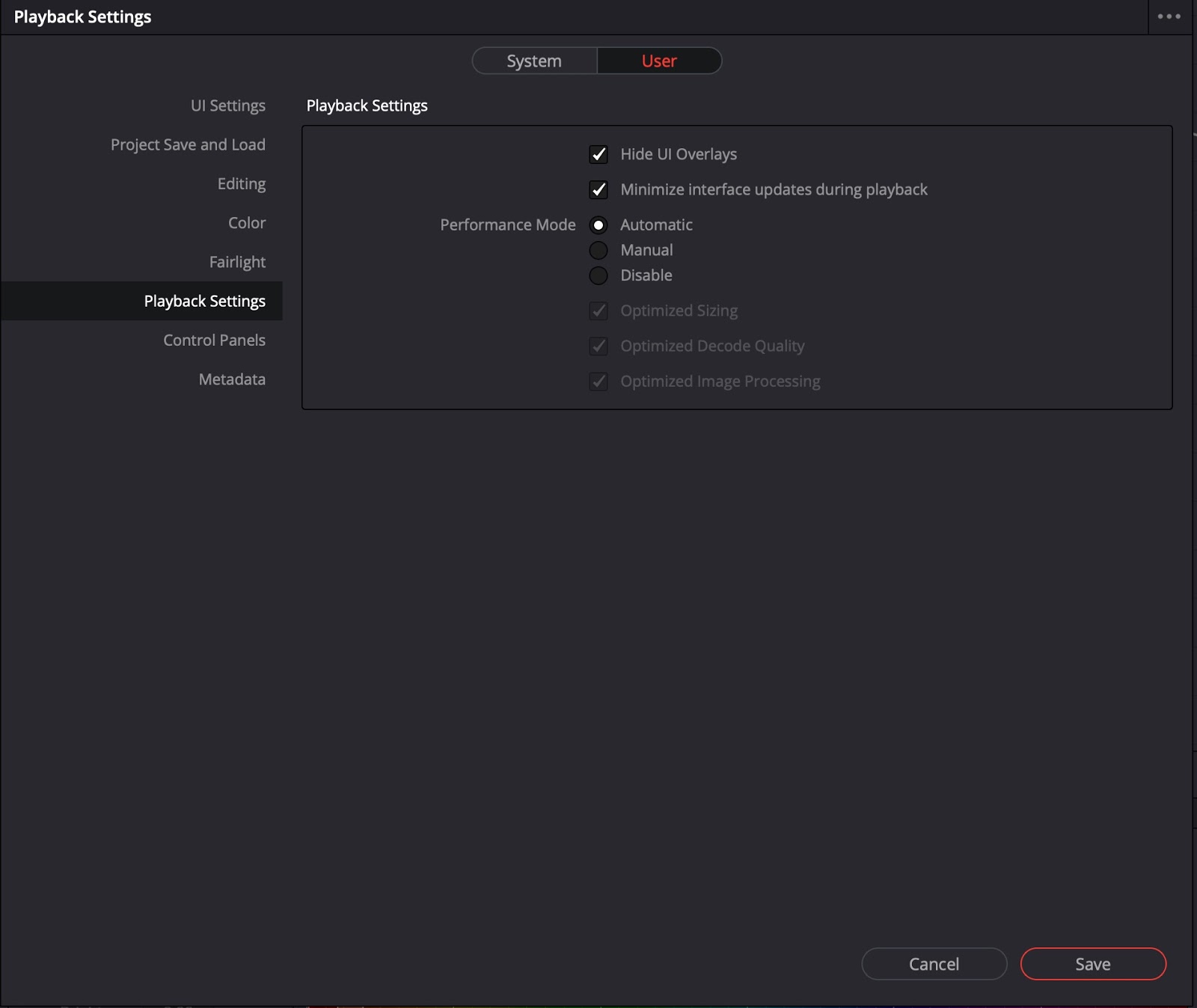
Past default, Performance Mode is automatically enabled, but you can adjust or disable information technology entirely in the Playback Settings tab of the User Preferences bill of fare (DaVinci Resolve > Preferences > Users > Playback Settings).
I recommend ii useful settings in this bill of fare chosen "Hide UI Overlays" and "Minimize interface updates during playback." These settings sacrifice on-screen controls (such as mouse, power windows, and carve up-screen controls) during playback, which tin can usually squeeze out a few actress frames-per-second from the GPU.
I other important tidbit to know. While Resolve and Resolve Studio are very similar, Resolve Studio utilizes improved treatment for mutual compressed codecs such as H.264 and H.265 and supports hardware acceleration.
This tin can significantly speed up playback, transcoding, and exports of those formats. But this improved performance is not included in the free version of Resolve, which might tiresome down functioning slightly if you're using those codecs..
2. Proxy Mode
First, let's clarify, Proxy mode is not for the typical "online/offline" proxy workflow.
On the contrary, Resolve's Proxy manner temporarily reduces the processed resolution of an entire timeline, but without impacting the actual assets or sequence settings.
It'due south like irresolute the timeline resolution within Project Settings from UHD to HD while working (edit, colour grading, etc.) and then switching back to UHD before final output. All your assets and effects are still UHD data, they're just being candy as if they were HD during playback.
Since DaVinci Resolve was designed to be resolution independent, you can brand these adjustments to the project without fear of losing asset/sequence quality. So don't worry, you can use Proxy Way without it throwing off your finely-tuned, shot-specific adjustments, like keyframes, power windows, tracking, etc.
Note: Temporarily changing the timeline resolution is essentially like making your own custom proxy manner, if you want more than command. Just don't forget to change it back before render.
The controls for Proxy Mode via the Playback menu, where you'll observe two options: Half Resolution and Quarter Resolution.
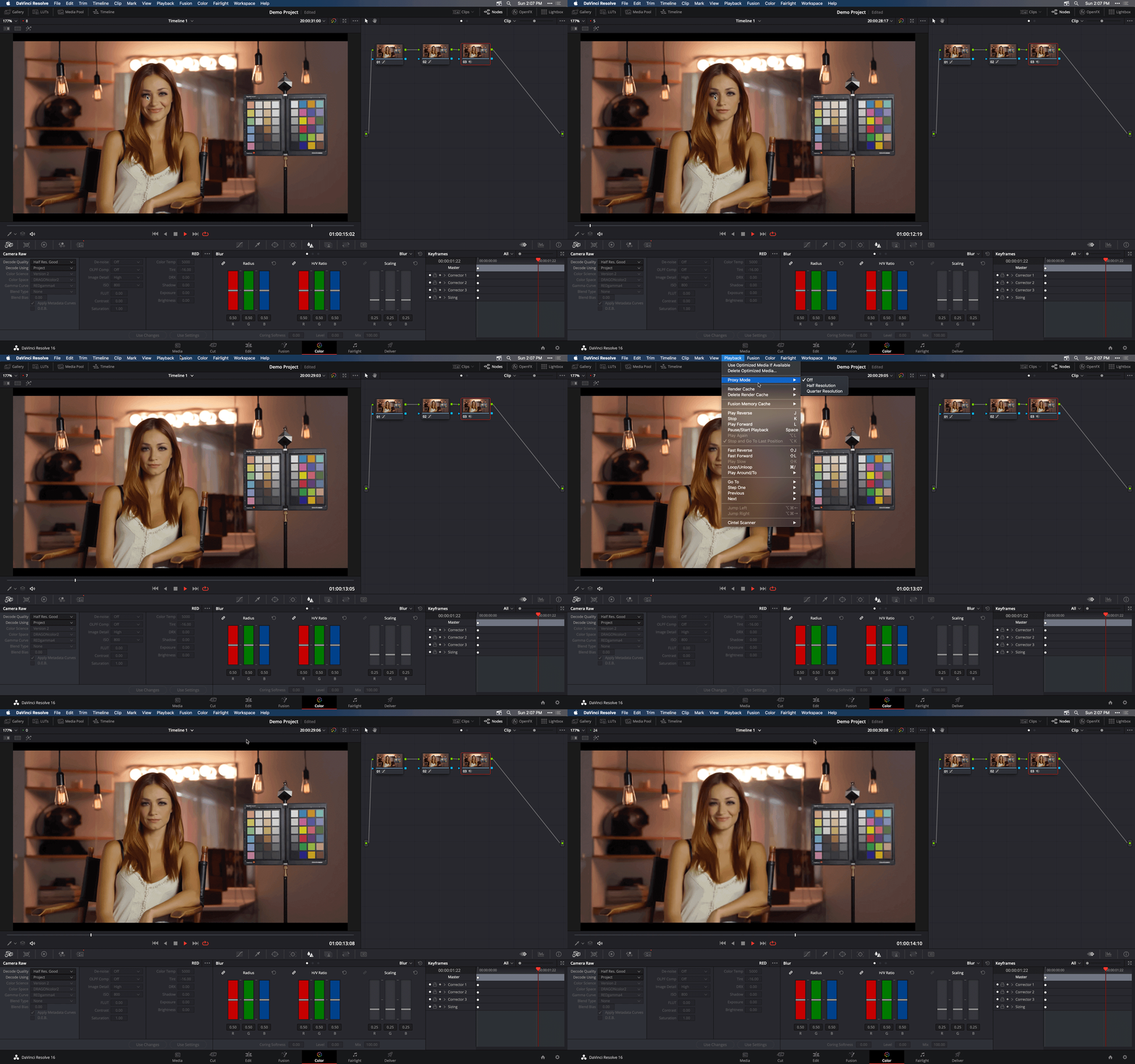
I recommend trying Half Resolution first to see if you get a green GPU Status indicator during playback. If that's non enough, Quarter Resolution volition almost certainly practice the trick (unless you're working with 8K RED Helium footage).
Quarter Resolution may wait a bit blurry, only smooth playback is usually much more important to your artistic decisions than the actress pixels.
Unfortunately, if your specific performance limitations are due to your source media, Proxy Way probably won't exist much help.
Fortunately, Resolve has other tricks for just this scenario.
3. Create optimized media
Optimized Media is basically Resolve'southward equivalent of offline proxies.
Information technology takes the original avails, and creates lower-quality versions that y'all work with, earlier returning to the original quality avails before output.
This is especially useful if you are using computationally-intensive formats, such as heavily compressed H.264/H.265 (mirrorless cameras, drones, and cell phones), high-resolution raw (Reddish, Blackmagic, Arri cameras), and even OpenEXR or DPX image sequences (similar are used in VFX workflows).
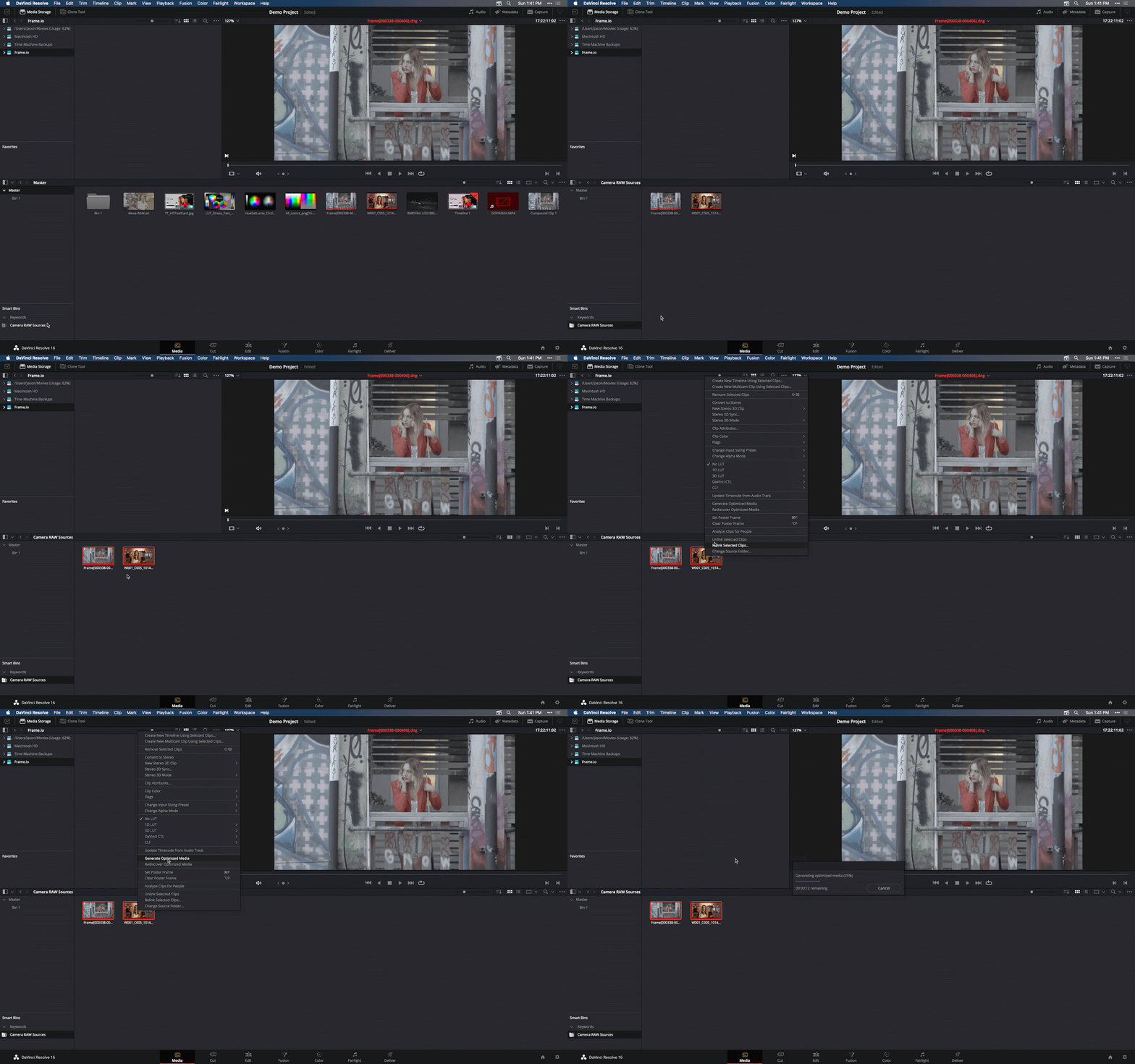
Dissimilar a lot of proxy workflows, Resolve automatically manages the Optimized Media procedure without much user input or technical setup.
Simply correct click the clips you lot'd like to optimize and then select "Generate Optimized Media." Resolve will intelligently select the best resolution for the proxy media (based on the timeline resolution), and so create the proxy assets directly on the scratch disk.
You can even utilise a Smart Bin to intelligently sort through media to help you optimize certain media, such as RED and CinemaDNG camera raw files.
The all-time part is that there is no need relink the original avails earlier output. Resolve's process takes away most of the hassle mostly associated with proxy workflows.
You can hands switch back and forth between the original (non-proxy) source media and the optimized (proxy) files via the "Use Optimized Media" toggle under the Playback Menu.
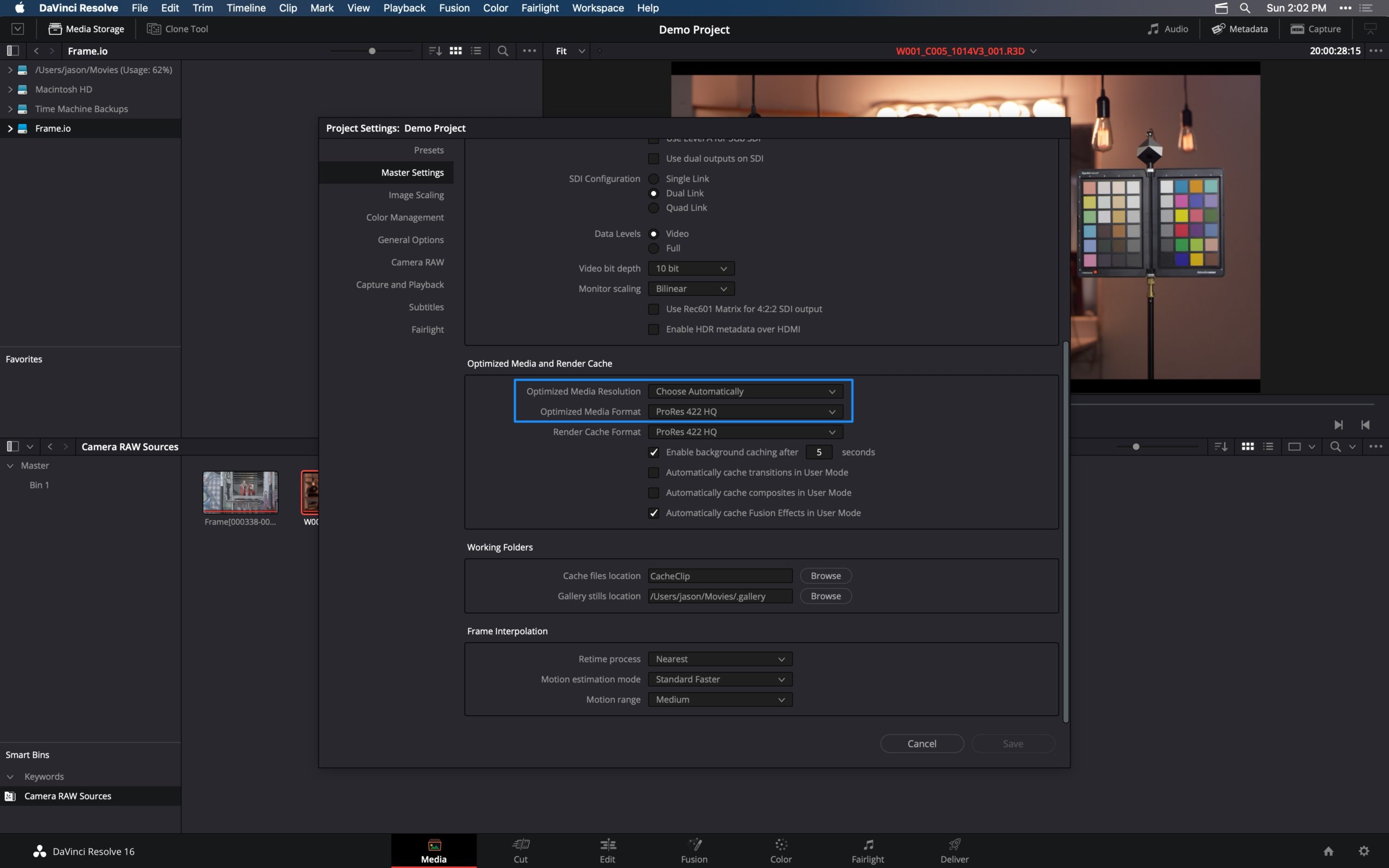
If you'd like to customize the options used to create your optimized "proxy" media, you can practice that in the Project settings (Project Settings > Master Settings). Like other proxy workflows, you can manually select the resolution and codec used, which gives you much finer command of your workflow.
For example, if you're utilizing raw camera sources and desire to starting time preliminary grading on the optimized files, you can specify ProRes 4444 or DNxHR 444 to avoid clipping/data loss. That volition give you plenty of room to explore your grading options without the computational burden of raw.
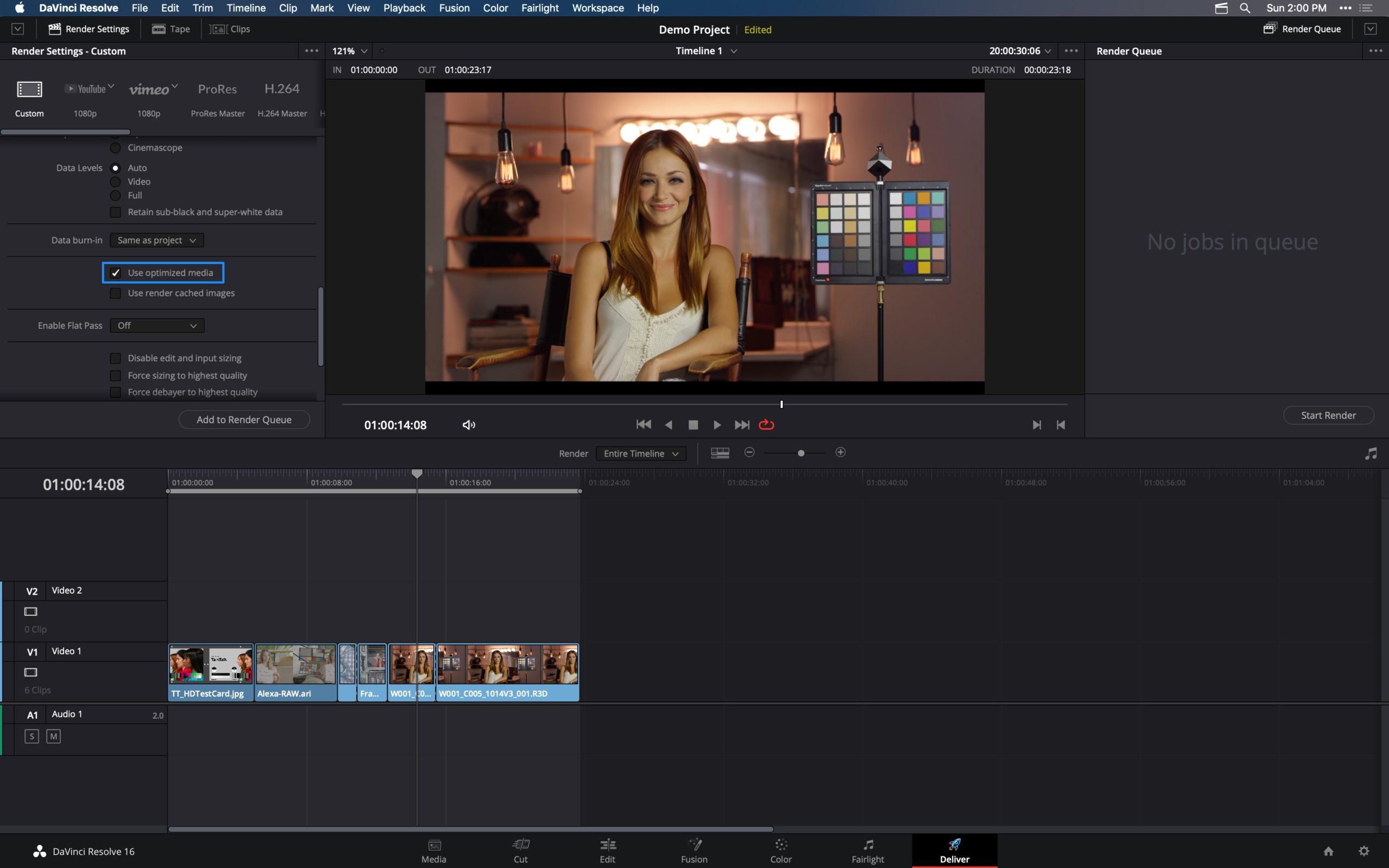
You can even force Resolve to utilize the Optimized Media equally the source for exporting a "review" screener, similar you might upload to Frame.io. This can radically improve consign speeds.
These settings alive in the Deliver tab. Just check the "Utilise optimized media" option in the "Custom" video options preset under the "Advanced Settings."
4. Caching
DaVinci Resolve has the ability to cache, or "pre-return," its entire timeline to a more processor-friendly format with all the edits, color grading, and effects "burned-in" to a single stream of media.
This typically results in smooth, seamless playback, though it comes at the expense of render times and storage space.
Despite the added return requirement, caching can help with a diverseness of the bug we've discussed already, from processor-intensive media to an effects heavy timeline, and can even help your aging workstation achieve real-time playback.
On the edit page, you can come across if clips are buried by the red bar that appears forth the lesser of the timeline ruler. A blue bar indicates the clip has been successfully buried, while a carmine bar indicates the clip has yet to be cached.
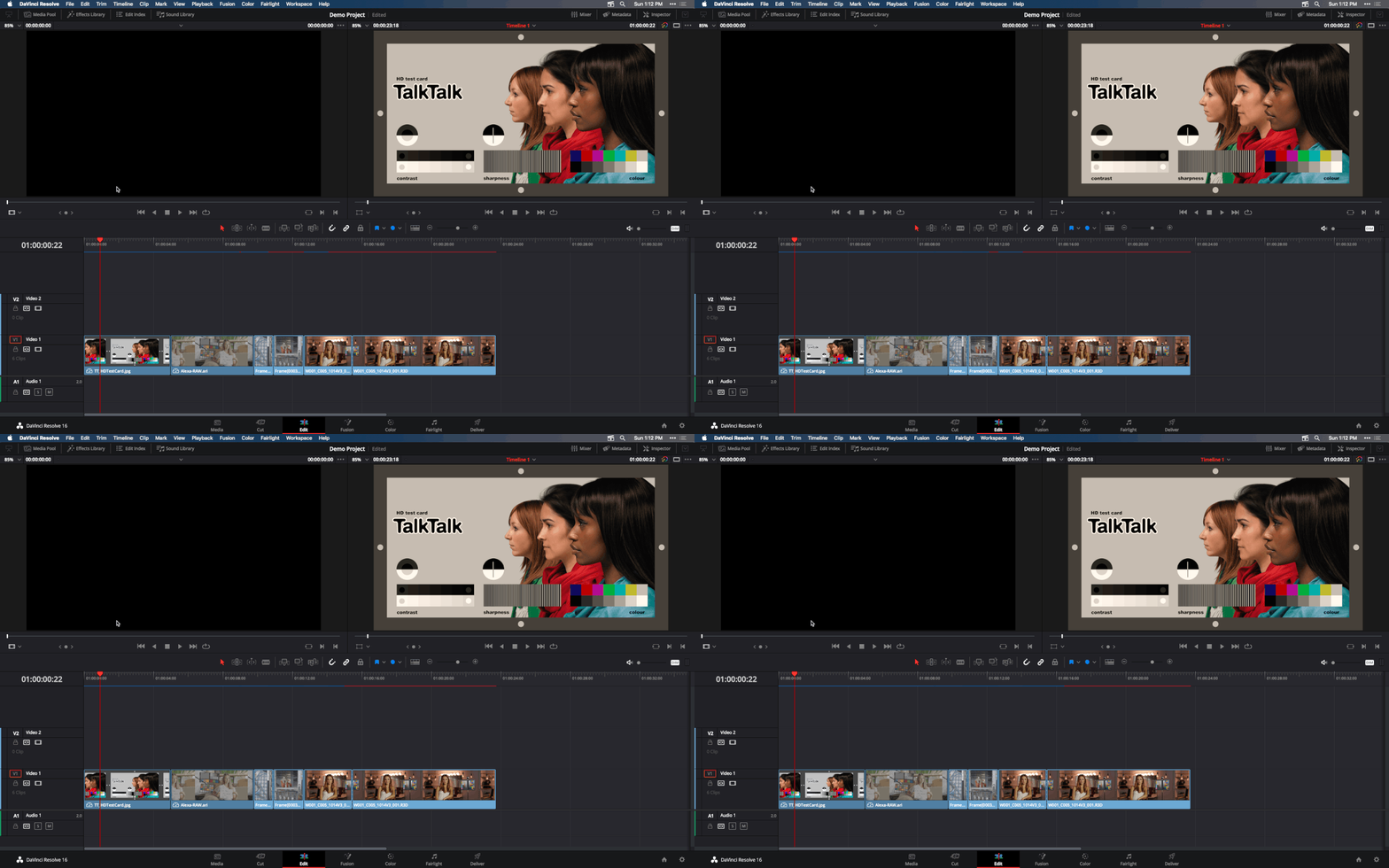
On the color page, you will notice like ruby and blue indicators on the nodes. These indicate that a specific node is cached.
Y'all'll notice caching occurs whenever you lot manually play back uncached clips (marked in red). A feature called Groundwork Caching will also kick in whenever the figurer is idle for more 5 seconds.
You can suit the settings for caching within the Projection Settings Project Settings > Master Settings > Optimized Media and Render Cache).
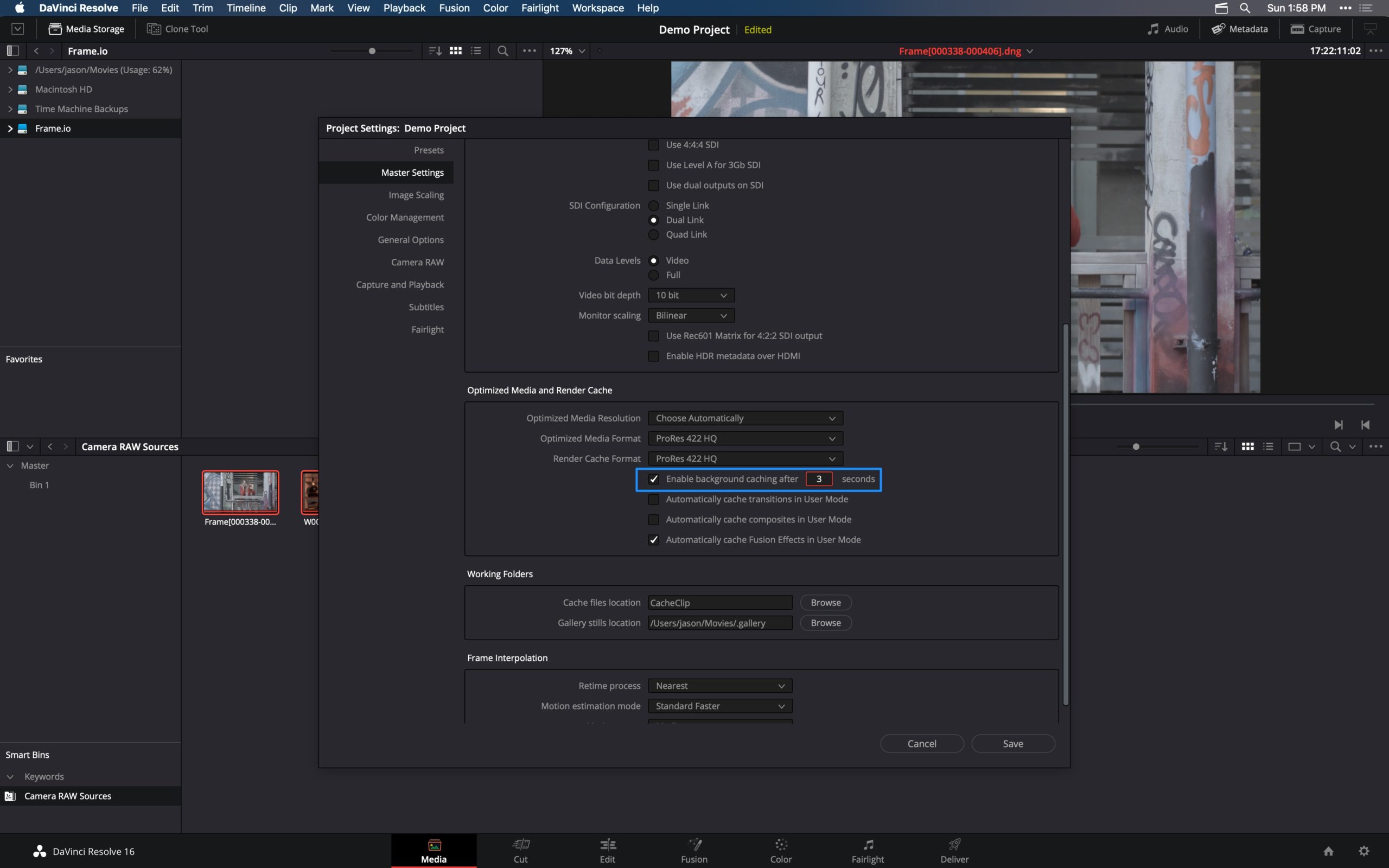
At that place are 2 main options for caching: Smart Manner and User Mode.
Smart Way provides a "set-it-and-forget-it" style of caching, which automatically enables caching for known operation-intensive media and furnishings, while still providing some transmission control over caching on individual nodes.
With User Mode, caching isn't set up up automatically, and leaves the caching process upward to you.
At that place are as well some adequately advanced workflow settings, such equally utilizing the "Render Cache Fusion Output." This setting pre-caches raw media at the timeline resolution in addition to the full quality resolution, and which avoids having to debayer the media during output.
v. Combine and conquer
Ane of the most powerful aspects of these features is they don't need to exist used independently of each other. Yous tin can easily combine several of these features to optimize your workflow and obtain real-time playback.
For example, yous may create optimized media of your 4.6K BlackMagic raw media to better their playback, while temporarily using proxy mode to meliorate operation of the UHD timeline. Y'all can then add caching into the mix to improve the operation of clips with temporal noise reduction and third-party OpenFX effects applied.
Each of these five tools and strategies functions well on their own, simply tin can be combined for greater outcome when needed.
Decision
As y'all tin see, DaVinci Resolve is not a ane-trick pony in terms of performance optimization. It offers a variety of features and settings that you can fine tune for your specific reckoner or workflow.
If yous effort one characteristic and it doesn't work, be sure to try one of the others, and don't forget to mix and lucifer. Resolve is an incredibly adjustable awarding, and with these features y'all tin can realize your creative vision even if you don't accept a maxed-out Mac Pro.
Practise you use any other performance hacks in DaVinci Resolve? Let united states know in the comments.
Source: https://blog.frame.io/2020/02/24/davinci-resolve-performance/
0 Response to "How Does the Time Read Da Vinci Resolve"
Post a Comment